Reviews of The Firing
View The Firing on
John Foster, BBC Antiques Roadshow Expert
Edited advance review
‘Shiban is a brilliant writer. In this dramatic treatment of Coade’s story, her meticulously researched source material is handled with considerable clarity and skill. With an Austenian flavour to the writing – deftly achieved without pretension or artifice – the reader is transported into Coade’s world of Georgian high society, dust-filled workshops, and bustling London streets. It is insightful, compelling, and at times deeply moving. Shiban’s enthusiasm for her source material, reflected in Coade’s irrepressible enthusiasm for her own craft, shines through the prose. It is an infectious enthusiasm of the very best kind, which makes for a thoroughly compelling – and highly recommended – read.’
Full review
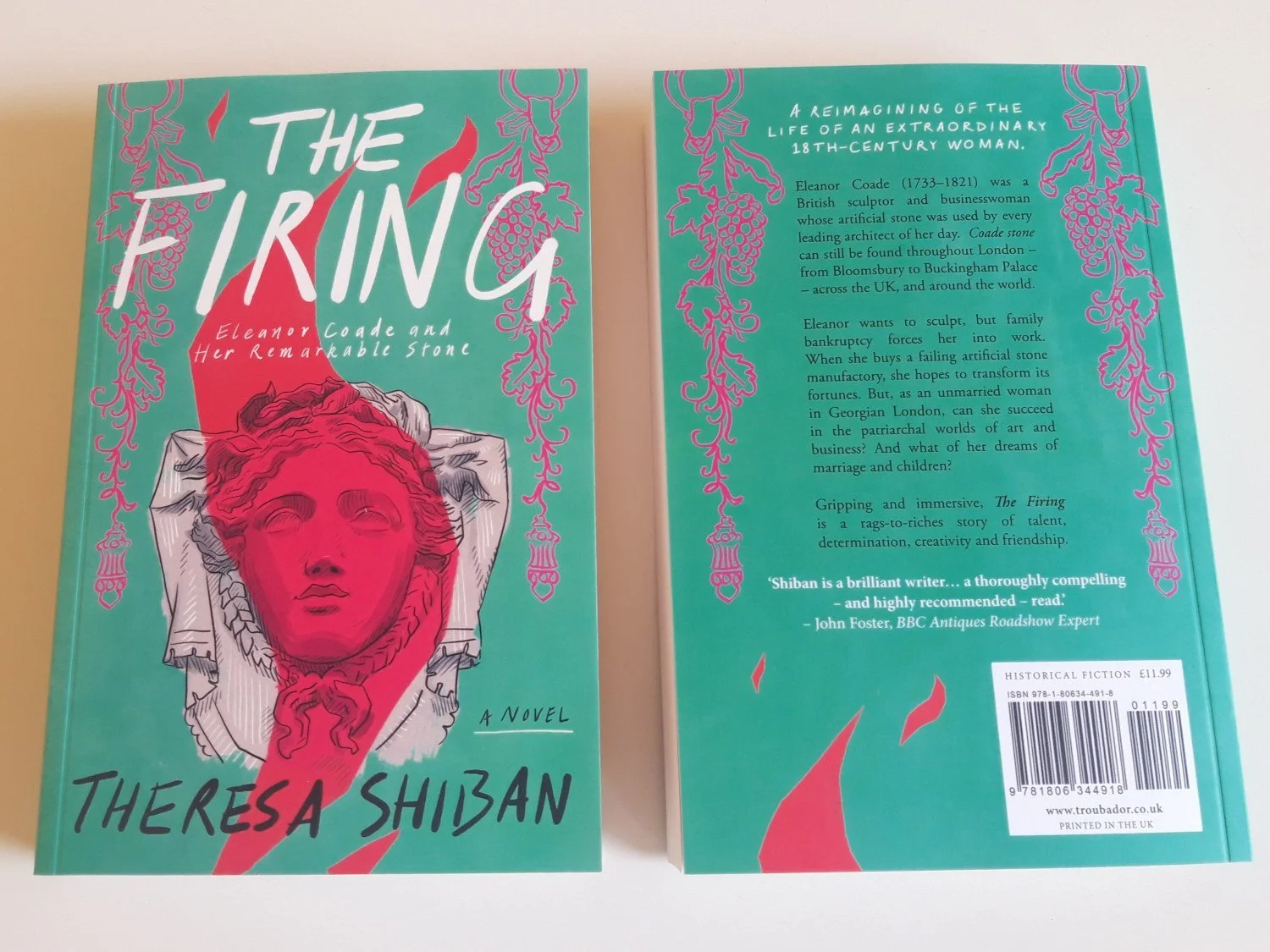
The Firing, by Theresa Shiban, is a historical novel detailing the life and times of Eleanor Coade, the remarkable artisan and entrepreneur whose ‘artificial stone’ dominated Georgian architectural decoration and statuary throughout the late 1700s. Coade stone, as it came to be called, was formed from a precisely measured admixture of clay and finely ground potsherds, glass, flint, and quartz. For the first time, classical statues and other decorative ‘stone’ pieces could be reliably moulded and fired in a kiln rather than laboriously hewn from a sculptor’s block. Cheaper, harder wearing, quicker to produce, and virtually indistinguishable from their natural stone equivalents, Coade’s works soon became de rigueur for all Georgian architects of note. From her modest manufactory in Lambeth, her designs were dispatched to all corners of Britain and beyond, with eager customers even extending as far abroad as America and Russia. From start to finish, it is a story of inspiring enterprise, innovation, and artistic vision.
Shiban is a brilliant writer. In her dramatic treatment of Coade’s story, Shiban handles her meticulously researched and referenced source material with considerable clarity and skill. Written in the first person from Coade’s perspective, the writing style – and indeed the narrative – has a distinctly Austenian flavour to it, deftly achieved without pretension or artifice. Although Coade’s career and the development of her artificial stone always remain central to the plot, the narrative of her life serves as a solid foundation from which deeper themes are explored. These include the heavy and often contradictory social mores incumbent upon women of that era – to marry, to bear children, to be devoted and dutiful daughters to their own parents – as well as the challenges imposed upon any industrious woman that dared encroach upon such a male-dominated domain as sculpture. Shiban’s treatment of these themes is insightful, compelling, and at times deeply moving, especially in the moments when Coade considers her own mortality and that of those around her. Perhaps Shiban’s greatest achievement, however, is her ability to readily transport the reader into Coade’s world of Georgian high society, dust-filled workshops, and bustling London streets. Shiban’s enthusiasm for her source material, reflected in Coade’s irrepressible enthusiasm for her own craft, shines through the prose. It is an infectious enthusiasm of the very best kind, which makes for a thoroughly compelling – and highly recommended – read.
Rosemary Griggs, author
Goodreads review: ★★★★★
I was lucky enough to receive an advance copy of The Firing, due for publication on 28 September 2026, from the author. Having seen memorials made of Coade stone in a Devon church, and a TV documentary about a house in Lyme Regis where Eleanor Coade lived, I was keen to find out more. Eleanor’s story begins in Exeter, where her life seemed set to follow the pattern of many a well-to-do woman of her time; marriage to a local gentleman, and a family. However, a family bankruptcy changes everything. Forced to earn her living, Eleanor buys a failing artificial stone manufactory.
Eleanor’s achievements as a sculptor and businesswoman whose artificial stone still graces famous buildings, including Buckingham Palace were exceptional. This beautifully written book conveys a strong sense of the realities of life for women in early 18th-century society. Theresa Shiban brings out Eleanor’s determination and resilience, while sensitively conveying the trade offs a woman must make to succeed. I thoroughly enjoyed this story of a resilient, determined and talented woman who ran a successful business in Georgian London for 50 years. Highly recommended.